The Paperboy Didn’t Do It

Has not God made foolish the wisdom of the world?

~ 1 Corinthians 1:20

The paperboy didn’t do it, although he was implicated. His ink-stained hands were all the evidence they had at the time. But it wasn’t the paperboy who killed the daily newspaper.

I am greatly relieved to know this. I was a paperboy. The inked creases of my hands lent credibility to the old axiom that printer’s ink courses through the veins of a real newspaperman. I wanted to be one of them.

Most kids get a paper route to earn money. A few of us, inspired by intrepid reporters in the movies making the world a better place, wanted a part in the crusade. The paperboy was the last piece of a vast machine to inform the public. In the 1960s, it was his job to get the paper on the front step, before the evening newscasts, while it was fresh, when it was still news.

The newspaper didn’t always make it to the front step. A 32-page edition was most likely to land near it when tossed from a moving bicycle. We tucked newspapers behind the storm door when the weather was poor. We collected cash payments from our customers on Friday. We learned to prop a foot against the screen door before knocking to keep the watchdogs contained. In winter we warmed our hands by cupping the Christmas lights. Hands that were still numb were scoops for the loose change in our pockets. The customer could pick his own change if he was a cheapskate.

I was also a journalist for a time who survived college training as rigorous as a bicycle paper route in a snowstorm. We were not to use cliches, which only revealed mediocrity in writing, or adjectives without attribution. We were to be objective. Never, ever (outside of a direct quote) use an exclamation point. That would be like sticking a thumb in the reader’s eye or laughing at your own joke. Do not become part of the story. Follow the rules of grammar.

A curious last class before graduation proffered that newspapers would have to adapt to survive. Broadcast journalism was already the primary news source for many in the 1970s. The newspaper industry relied on a workforce of mostly children to get the finished product to the customer on time and in good condition. It couldn’t last.

There was adaption. The daily newspaper that survives today usually arrives on a glass surface. In the digital age we prefer social media to print, where, according to Reuters, one of the last surviving global news organizations, “one can find news to reflect one’s already formed and unblinking opinion.” In an age requiring an average intellect to sort endless streams of information and misinformation, we created an artificial one.

No, the paperboy didn’t kill the daily newspaper.
Know, Love, Serve

Of the three primary means to get to Heaven, we may be intimately familiar with only two of them.

We live in families and communities, so loving and serving (or the need for them) is often plainly evident. It’s the knowing God that is a challenge for most, for it is not entirely possible to know a mystery.

Some may come to know Him through prayer. Others may require another medium, such as good Catholic books. There are plenty of them.

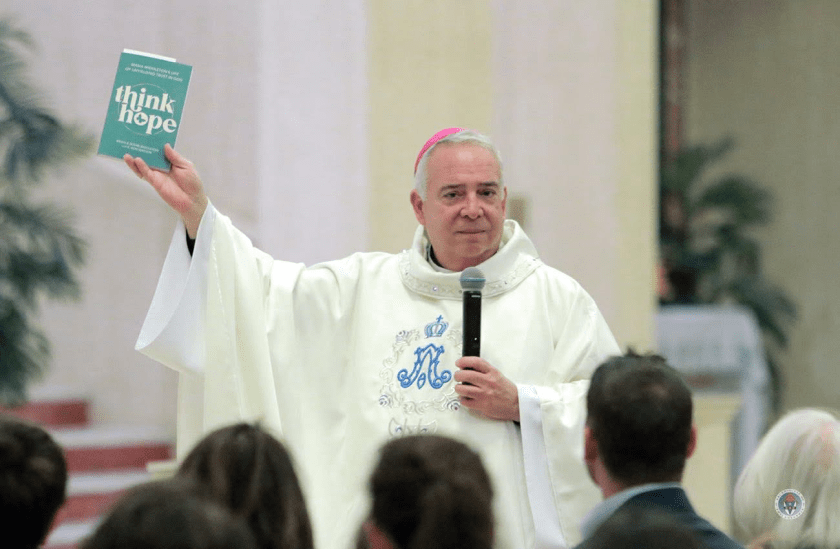
We are grateful for and humbled by the many positive reviews, given in writing and in person, for “Think Hope,” the book I co-wrote with the parents of Maria Middleton, Brian and Susan.

Maria’s story did not place among the top three biographies recently published, but it was one of six finalists in the category for the 2026 Excellence in Publishing Awards by the Association of Catholic Publishers.

Only God knows the good that can come from reading one good Catholic book.

~ St. John Bosco

Thinking Hope

“Think Hope,” the story of Maria Middleton’s unyielding trust in God, is a finalist in the Excellence in Publishing Awards of the Association of Catholic Publishers.

The book I co-authored with Maria’s parents, Brian and Susan, is one of six finalists in the biography category. First, second and third place winners will be announced in June.

The competition for best biography is stiff, including two books about Pope Leo XIV. Maria’s story is already a success, however. Her life and death, in her words and actions, is an antidote to despair in our time and a glimpse of Heaven.

“Only God knows the good that can come from reading one good Catholic book,” St. John Bosco wrote.

We hope you find that Maria’s book is one good Catholic book.

Read more:

News release from Ascension Press, publisher of “Think Hope”

News release from Association of Catholic Publishers

Archbishop Nelson Perez of Philadelphia celebrated Maria’s fifth anniversary Mass in October 2025.

‘What is truth?’

These are the words of Pilate to Jesus moments before sentencing Christ to be scourged. Pilate then told Jesus’ accusers that he found “no crime in him.” (John 18:38)

So much for Pilate’s “truth.”

Journalists, apparently, have a similar question for us.

“How do we report the truth while minimizing harm?” is the leading question to encourage participation in a survey conducted by the Society of Professional Journalists.

Perhaps we see where this is headed.

We keep asking the same question, hoping for a more satisfactory answer.

Jesus provided the answer, however, and it the same for Pilate’s time as well as our own.

“For this I was born,

and for this I have come into the world,

to bear witness to the truth.” (John 18:37)

Listen to Him.

When Fish Rise

Dear Reader: “When Fish Rise” is the story of a friendship and discovery of faith, something we may not have been looking for at first. We became friends in the place where we first learned to flyfish, a point of reference throughout our 40 years. He became a master and I am still not very good at it. It didn’t matter in the end. We found something greater.

“The very condition of having Friends

is that we should want something else

besides Friends.”

 ~ C.S. Lewis

We were a small group, mostly unknown to each other and brought together by shared interest in a philosophy class and a professor with the magnetism of a favorite uncle. He was standing waist-deep and fly casting in a small Poconos stream.

It was 1972 and we were freshmen in a secular university. We were reading a few of the ancient Greek philosophers and discussing their observations on logic, reason and truth: all three in harmony and intrinsically recognizable by most people. I was surprised to find illumination of my Catholic faith in this setting, without reference to Christianity in the teaching. Twelve years of Catholic schooling had failed to imprint the tradition of the Greeks and their influence on my faith, or perhaps I hadn’t been paying attention. This professor awakened something buried deeply, but at first all he seemed to want was nothing more than for us to break the horns of a moral dilemma – when either one of two choices is perceived as equally bad – by proving one or the other horn false using logic, reason and truth rather than the slogans of the day.

Continue reading: https://erwatsonblog.com/when-fish-rise/